
If Everything Is More Efficient, Why Are We Busier Than Ever?
Sep 18, 2026Modern life has made almost everything more efficient.
We have AI to help us think, write and organize. Food can arrive at our door in minutes. Technology automates tasks that used to take hours. We can outsource work, cleaning, administration and almost anything else if we have the means.
So why does it feel like we have less time than ever?
Something isn’t adding up.
Every time we save time somewhere, we seem to fill it with something else. We outsource a task, then add another task. We finish something faster, then expect ourselves to do more. We become more efficient, but not necessarily more intentional...
And I see this in corporate life too.
A process becomes faster, but instead of giving people capacity back, another meeting appears. AI takes something off someone’s plate, but three new expectations replace it. Technology gives us greater access to each other, and suddenly everyone is accessible all the time.
Efficiency was supposed to give us time back. Instead, we often use it to increase the amount we expect from ourselves.
And perhaps we are asking the wrong question.
Instead of only asking:
"How can I save more time?"
The right question perhaps is:
"What am I doing with the time I’ve saved?"
And:
"What am I still doing simply because I’ve always done it?"
This matters whether you lead a company, manage a team or are simply looking at your own life.
If something becomes more efficient in your team, you have some choice over what fills that capacity. If you no longer spend Sunday afternoon grocery shopping because your groceries are delivered, you have some choice over what fills those hours.
Of course, not everything is within our control. But more of it is than we sometimes acknowledge.
For me, gaining time back comes down to three practices.
1. Presence
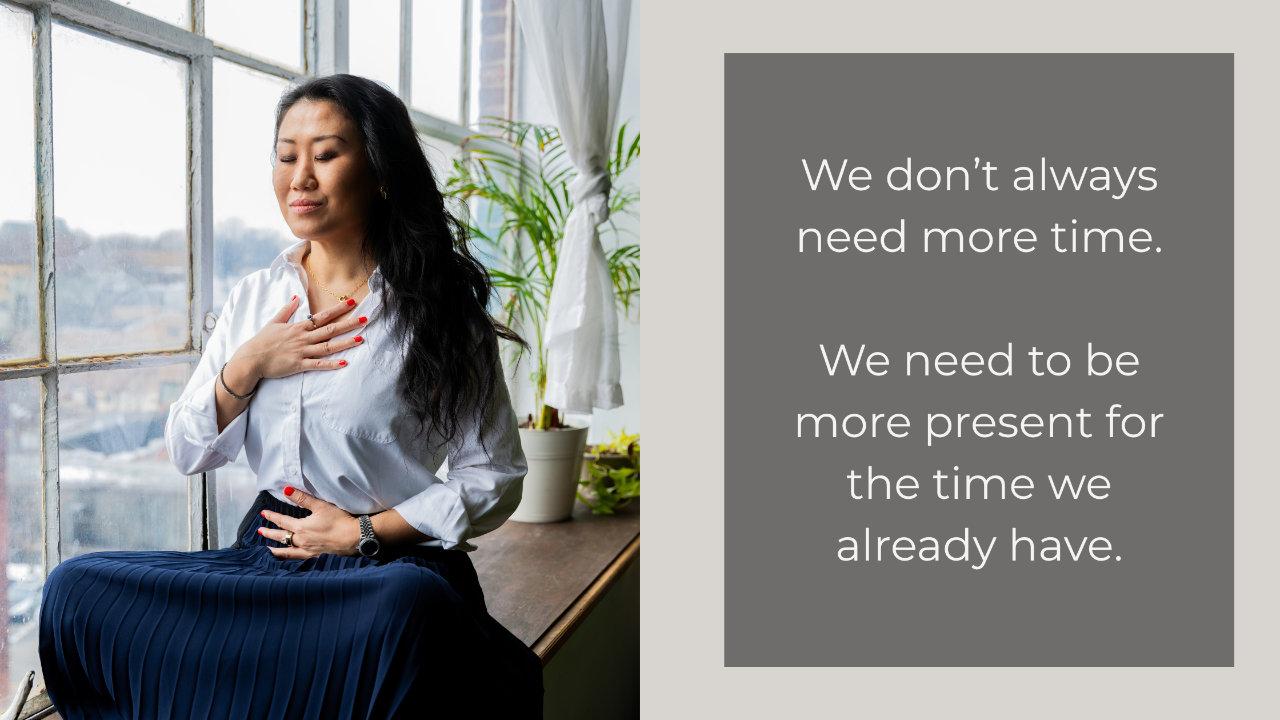
Presence isn’t only a mindfulness practice.
It’s a way of using our time better.
When you’re fully engaged with what you’re doing, there is less mental energy spent replaying what happened yesterday, anticipating what could happen tomorrow, checking something else, or thinking about the five things you still need to do.
You notice more.
You make better decisions.
You listen differently.
And you’re far more likely to recognize when something you’re doing no longer makes sense. That’s important because autopilot is expensive. Not necessarily financially. But in hours, attention and energy.
We continue routines because they are routines. Attend meetings because they exist. Follow processes because nobody has questioned them. Say yes because we said yes last time.
Presence allows us to notice. And once we notice, we have a choice.
2. Remove the distractions
This one sounds almost too simple.
Clean your desk. Close the tabs. Turn off the notifications.
But look at how difficult we have made it to do one thing at a time.
If you need 25 tabs open because otherwise you won’t remember what you need to do tomorrow, perhaps the answer isn’t keeping 25 tabs open.
Write it down.
If you can’t close a document because you’re afraid you won’t find it again, perhaps you need a better system for organizing your files.
If every notification can interrupt you, decide which ones actually deserve that privilege.
Our physical and digital environments are constantly asking something from our attention.
And every tiny switch has a cost.
Removing distraction isn’t about creating the perfect minimalist desk or becoming impossibly disciplined. It’s about making it easier for your attention to stay where you chose to put it.
3. Give your time boundaries
I work very differently when I tell myself:
"I have one hour to do this."
Not all afternoon.
Not “I’ll get to it today.”
One hour.
That boundary creates useful pressure.
It makes me less likely to perfect something that doesn’t need perfecting. Less likely to wander into my inbox. Less likely to turn one task into six.
There is a name for part of this phenomenon: Parkinson’s Law: the idea that work tends to expand to fill the time available for its completion.
Give yourself an entire day, and something can easily take an entire day.
Give yourself a focused hour, and you may be surprised by what gets done.
This doesn’t mean rushing through everything. It means being deliberate about what deserves your time and how much of it you are willing to give.
The point isn’t to become more productive
This is where I think many conversations about time go wrong. We learn how to save 30 minutes so we can fit another task into those 30 minutes. Then we wonder why we’re exhausted.
We don’t want to gain time simply so I can produce more. We want to gain time so I can live more of it.
To have a conversation without looking at our phone. To walk somewhere without rushing. To spend time with people we love. To do meaningful work with our full attention.
And to have moments where absolutely nothing needs to be accomplished.
Technology will continue becoming more efficient. AI will continue helping us do things faster.
But neither can decide what deserves the time we get back. That part is still ours.
So perhaps the question to ask yourself isn’t:
How can I fit more into my day?
It’s:
What is worthy of the time I have?
I hope this is useful, and feel free to leave me a note: info@pauline-leung.com and would love to hear from you!
Stay connected with news and updates!
JOIN the mailing list to receive the latest news and updates.
Don't worry, your information will not be shared.
Unsubscribe any time.
