
The Future of Work Is More Human Than We Think
Jun 16, 2026A month has passed since I attended the World Happiness Summit in Cascais, Portugal as a Coach Facilitator.
I’ve been studying the Science of Happiness since 2014. Before founding Flow Grounds in 2023, I spent 19 years at L’Oréal in leadership roles across Europe, Asia, and the United States. Today, I teach Happiness at Work, coach leaders and professionals, and help organizations create environments where people can thrive.
I attended the Summit as a participant as well, because I wanted to learn from researchers, physicians, psychologists, business leaders, and practitioners who are advancing the conversation around wellbeing, leadership, mental health, human flourishing, and the future of work.
As I reviewed my notes in the weeks that followed, one thing became clear.
Although the speakers approached their work from different disciplines, many were exploring the same challenge:
How do we help people thrive?
A physician spoke about stress. A researcher spoke about mindfulness. A psychologist spoke about forgiveness. Business leaders spoke about culture, wellbeing, and leadership.
Different perspectives. Similar conclusions.
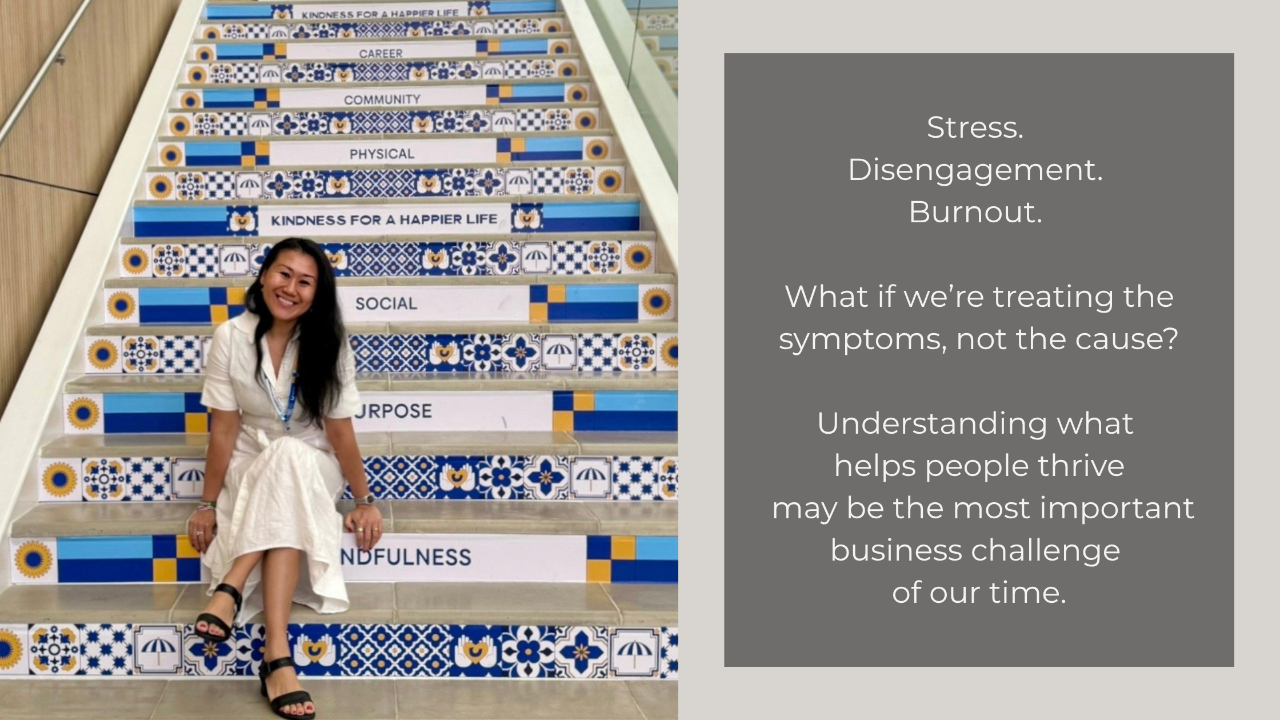
For all the attention we give to artificial intelligence, productivity, and performance, many of the challenges showing up inside organizations today are deeply human.
And that’s why I left the summit more convinced than ever that the future of work is more human than we think.
1. Wellbeing Is a Leadership Issue
One of the most encouraging discussions featured leaders from organizations such as Unilever, Cisco, Siemens, and LEGO Group.
What stood out was not that they were talking about wellbeing. It was that they were talking about it as a business imperative.
For years, wellbeing was often treated as a benefit. Today, more organizations are recognizing that stress, burnout, disengagement, and poor leadership directly affect performance, retention, innovation, and culture.
One comment from Diana Han, Chief Health and Wellbeing Officer at Unilever, particularly resonated with me. She spoke about how stress can unleash unhealthy behaviors and highlighted the importance of self-awareness in leadership.
That observation has significant implications.
Most leaders spend years learning how to manage strategy, projects, operations, and budgets. Far fewer are taught how pressure affects their own behavior.
Yet anyone who has worked inside an organization has seen the impact. A stressed leader communicates differently, makes decisions differently, and influences culture differently.
Looking back on my years at L’Oréal, I can think of leaders who became more effective under pressure and others who became less effective. The difference was rarely intelligence or capability.
More often, it was self-awareness.
The leaders who understood their own reactions created environments where others could perform at their best.
2. Technology Will Never Replace Human Leadership
Artificial intelligence was a recurring topic throughout the summit.
Yet what I found most interesting was how often conversations returned to empathy, emotional intelligence, awareness, trust, and judgment.
LaFawn Davis, Board Director The World Wellbeing Movement, spoke about conscious leadership and reminded us that people are not a cost to be reduced.
That message feels increasingly relevant.
Technology can automate tasks and improve efficiency. What it cannot do is build trust, create belonging, or help people navigate uncertainty.
During my corporate career, some of the most important decisions I made were not based on data alone. They required judgment, context, empathy, and an understanding of people.
As AI becomes more capable, human skills become more important, not less.
The organizations that thrive in the future will not simply be those that adopt technology successfully. They will be the ones that combine technology with deeply human leadership.
3. Leadership Requires Emotional Maturity
One of the sessions that stayed with me most came from Dr. Frederic Luskin.
His work focused on forgiveness, a topic rarely discussed in leadership circles.
Yet perhaps it should be.
He spoke about releasing the bondage of what was done wrong, forgiving people’s ignorance, and accepting that human beings are imperfect.
After nearly two decades in corporate leadership, I have yet to see a successful career that did not include disappointment, conflict, misunderstandings, or difficult relationships.
The question is not whether those experiences happen.
The question is what happens next.
The leaders I have admired most were not the ones who avoided conflict. They were the ones who could navigate it without allowing frustration, ego, or old grievances to dictate their actions.
They held people accountable. They had difficult conversations. They made tough decisions.
But they did not allow resentment to become their leadership style.
That requires emotional maturity.
And in my experience, emotional maturity is one of the most overlooked leadership capabilities.
4. Performance Is Not the Same as Thriving
Another insight that stayed with me came from Dr. Judith Joseph and Nic Marks.
Dr. Judith Joseph spoke about High Functioning Depression and the reality that many high achievers appear successful externally while struggling internally.
Nic Marks shared research suggesting that boredom may impact happiness at work even more than stress.
Together, these insights point to a challenge many organizations overlook.
We tend to measure performance because performance is visible.
Thriving is harder to see.
A person can continue delivering results while feeling disconnected from their work.
A team can hit targets while slowly losing energy.
An organization can appear successful while people quietly disengage.
The more I reflected on Nic Marks’ observation, the more it aligned with what I have seen throughout my career.
Many professionals are not only struggling because they have too much work.
Some are struggling because they no longer feel challenged, connected, or inspired by what they do.
The most successful organizations of the future will understand that thriving and performing are not the same thing.
And they will invest in both.
Final Reflection
When I look back at my notes from Portugal, what strikes me most is how many different disciplines arrived at similar conclusions.
Whether the conversation was about stress, mindfulness, leadership, forgiveness, mental health, or artificial intelligence, the underlying question remained the same:
How do we create the conditions where people can thrive?
The answer is not another perk, policy, or initiative.
It is creating environments where people feel trusted, supported, challenged, connected, and able to do meaningful work.
For all the attention we give to technology, productivity, and performance, the future of work will continue to be shaped by deeply human factors.
The quality of leadership.
The strength of relationships.
The ability to navigate pressure without losing perspective.
The willingness to invest in wellbeing, not as a benefit, but as a foundation for performance.
The organizations that thrive in the years ahead will not be the ones that understand technology best.
They will be the ones that understand people best.
And perhaps that is the most important leadership challenge of all.
Stay connected with news and updates!
JOIN the mailing list to receive the latest news and updates.
Don't worry, your information will not be shared.
Unsubscribe any time.
